Digital marketing means promoting a business, a product or a service on the internet. When you find a shop on Google, see a post on Instagram, or get an offer in your email inbox – that is digital marketing.
This guide explains digital marketing in simple words. You do not need any experience to follow it.
What is digital marketing?
Marketing means telling people about what you offer, so they become your customers. Digital marketing does this through online channels: search engines, social media, email, websites and apps.
Here is an example. A small bakery posts photos of its cakes on Instagram. It shows its address and opening hours on Google Maps. Before a festival, it sends an offer by email. All three are digital marketing.
Digital marketing vs traditional marketing
- Traditional marketing – newspaper ads, posters, TV, radio and pamphlets.
- Digital marketing – Google, social media, email and websites.
Digital marketing has three big advantages:
- You can start with a small budget.
- You can choose who sees your message.
- You can measure the result: how many people saw it, clicked it and bought.
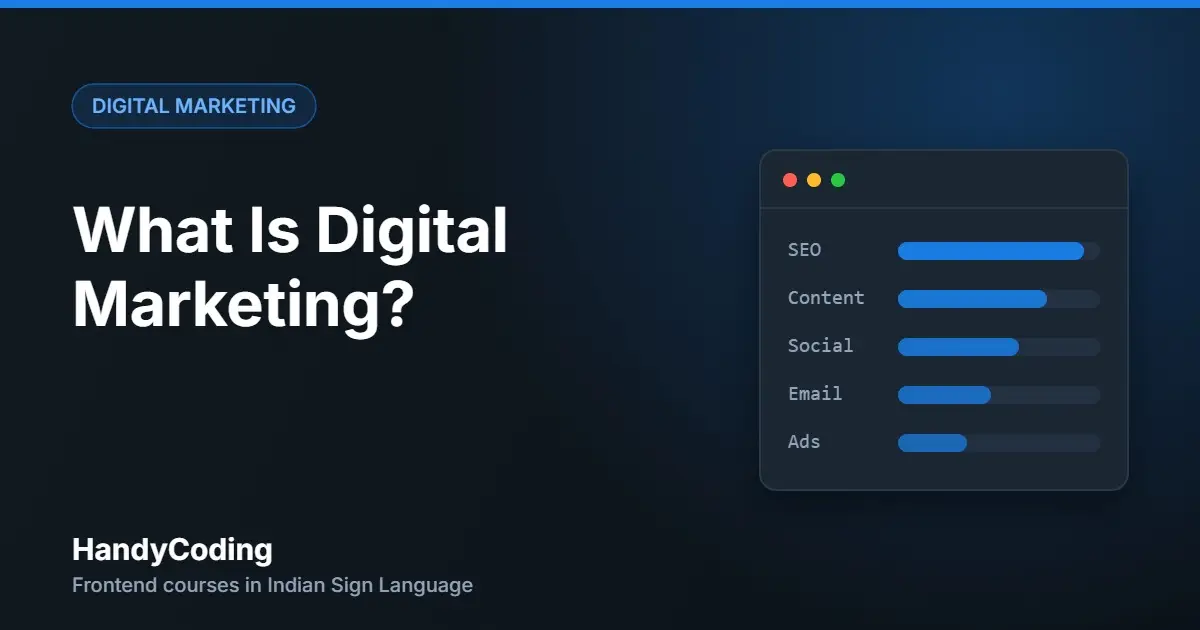
The main types of digital marketing
1. Search engine optimization (SEO)
SEO means improving your website so it appears higher in Google search results – without paying for ads. Example: someone searches “frontend course in Indian Sign Language” and finds your page.
2. Content marketing
Content marketing means creating useful content: blog posts, videos and guides. Helpful content brings visitors and builds trust. The blog post you are reading now is content marketing.
3. Social media marketing
This is marketing on Instagram, Facebook, YouTube and LinkedIn. You post regularly, answer comments and build a community around your brand.
4. Email marketing
You send news and offers to people who gave you their email address. It costs very little, and the email list belongs to you.
5. Paid advertising (PPC)
You pay to show ads on Google or on social media. PPC means pay-per-click: you pay when someone clicks your ad. Results come fast, but it costs money.
6. Affiliate and influencer marketing
Other people promote your product. They earn a commission or a fee for it.
Why every digital marketing plan needs a website
A social media page is rented space. The platform can change its rules at any time. Your website is your own space – and almost every channel sends people to it. An ad leads to a landing page. A Google result leads to a blog post. An email leads to a product page.
This is why basic web skills help a digital marketer. If you understand HTML and CSS, you can:
- Edit a landing page without waiting for a developer.
- Understand SEO basics: title tags, headings, alt text and links.
- Make pages fast and mobile-friendly.
- Add tracking codes, like Google Analytics, in the right place.
Tools to start with
These tools are free or have a free plan:
- Google Search Console – shows how your site appears in Google Search.
- Google Analytics – shows how many people visit your site and what they do there.
- Google Trends – shows what people are searching for.
- Canva – a simple design tool for social media posts.
How to start learning digital marketing
- Learn the basics – understand the main types above.
- Pick one channel first – for example SEO or Instagram. Do not start with everything.
- Build a simple website or blog – it is your practice ground.
- Create content regularly – one useful post every week is better than ten posts in one day.
- Measure – check what works with Search Console and Analytics.
- Improve and repeat.
Common questions
Is digital marketing hard to learn?
No. The basics are simple. But it needs practice and patience, because good results take time.
Do I need coding for digital marketing?
No, coding is not required. But basic HTML and CSS help a lot with websites, landing pages and SEO.
How long does SEO take to show results?
SEO is slow. It often takes several months to see clear results. Paid ads work faster, but they cost money.
Is digital marketing mostly written work?
Much of it is written and visual: blog posts, captions, emails, ad text, designs and reports. Teams and clients often work through chat and email.
Start with your own website
The best way to practice digital marketing is to have a website of your own. Our beginner course teaches you to build one from zero with HTML5, CSS3, responsive design and Bootstrap 5 – with Indian Sign Language (ISL) support.
New to websites? Read What Is Frontend Development? first.